


Continuous vs. Batch Manufacturing in Pharma and Biologics: A Practical Guide
Most medicines are still made the way they were 50 years ago: in batches. Raw materials go into a vessel, a step runs to completion, the material is held and tested, and then it moves to the next step. Continuous manufacturing turns that sequence into a flow, with material fed in and product taken out without stopping. Regulators now have a harmonized rulebook for it, and the question for most companies is no longer whether continuous is allowed, but whether it makes sense for their product.
This guide explains how the two modes differ for small molecules and biologics, what ICH Q13 requires, where the economics work, and the barriers that keep batch processing dominant.
Key Takeaways
- ICH Q13, adopted in late 2022, gives a common framework for continuous manufacturing of both chemical drugs and therapeutic proteins.
- FDA approved the first continuous process in 2015 (Vertex’s Orkambi). By one USP estimate, just over 15 marketed products are now made this way.
- Small molecule adoption is led by oral solid dose lines. In biologics, perfusion and continuous capture are common, but fully integrated processes remain rare.
- Economic benefits are real but conditional. Modelling shows the best option depends on company size, scale and phase.
- The main barriers are control strategy, residence time characterization, workforce skills and working batch assets, not regulatory acceptance.
Batch and Continuous: What Each Means
2015
First FDA approval of a continuous process
2022
Year ICH adopted Q13
15+
Marketed products made continuously (est.)
~9 mo
Faster approval vs. batch comparators (FDA)
In batch manufacturing, each unit operation (blending, granulation, compression, fermentation, purification) runs as a discrete step. Material is often held and tested between steps, and a batch is a fixed quantity made in one cycle.
In continuous manufacturing (CM), at least two unit operations are connected so that material flows from one to the next while the process runs. ICH Q13 applies to CM of drug substances and drug products for chemical entities and therapeutic proteins (ICH Q13, 2022). It does not require a fully end-to-end line. As one USP expert noted, only two connected unit operations are needed to qualify, and end-to-end integration is very rare (Pharma Manufacturing, 2025).
The first FDA approval of a product made by CM was Vertex’s Orkambi in 2015. Vertex followed with Symdeko and Trikafta, Janssen moved Prezista from batch to continuous, and Pfizer (Daurismo) and Lilly (Verzenio) also brought continuous products to market. By early 2022, six FDA-approved applications used CM for finished oral solid dosage forms (DCAT Value Chain Insights, 2023).
Small Molecules vs. Biologics
Oral Solid Dose Lines
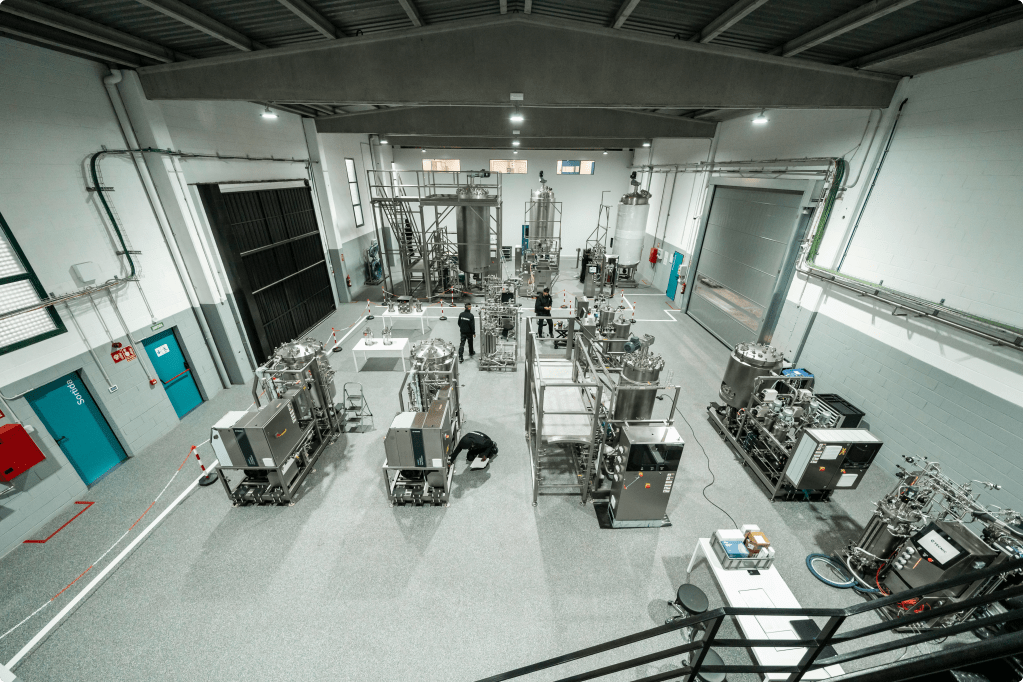
Small molecule CM is most mature in tablets. A typical line feeds API and excipients through loss-in-weight feeders into a continuous blender, then through direct compression or granulation, with process analytical technology (PAT) checking quality in real time. Thermo Fisher’s Greenville, North Carolina site runs a fully functional continuous line and is sunsetting its batch oral solid dose business there (Pharma Manufacturing, 2025). Drug substance adoption has lagged behind drug product.
Perfusion and Continuous Bioprocessing
Biologics have used continuous upstream processing for decades in the form of perfusion, where cells are retained in the bioreactor (for example by alternating tangential flow filtration) while fresh media is added and product is harvested. Downstream, multi-column chromatography loads several smaller Protein A columns in sequence, using resin more fully than a single large batch column. Linking these steps produces integrated continuous bioprocessing.
Sanofi opened a digitally enabled continuous biologics facility in Framingham, Massachusetts in 2019, claiming it was 80 times more productive than a traditional factory (PharmTech, 2019). That is a company figure, but it shows the scale of ambition. Even so, an Enzene executive told Pharma Manufacturing that continuous processing will not replace fed-batch within two years, while projecting that most products could use some continuous step over the long term (Pharma Manufacturing, 2025).
| Factor | Batch | Continuous |
|---|---|---|
| Batch definition | Fixed quantity per cycle | Defined by quantity, time or flow rate |
| Quality control | Hold and test between steps | PAT and real-time monitoring |
| Scale-up | Larger vessels | Run longer or add lines |
| Footprint | Larger equipment and holds | Smaller, integrated equipment |
| Deviation impact | Whole batch at risk | Divert affected material |
| Existing assets | Already built and validated | New investment needed |
The Regulatory Framework
ICH Q13 was adopted in November 2022. FDA issued it as final guidance in March 2023 (FDA, 2023), and it came into effect in the EU on 10 July 2023 (EMA). It builds on ICH Q7 to Q12 rather than replacing them. Key concepts include:
- Batch definition. The ICH Q7 batch definition applies to all modes of CM. Batch size can be set by output quantity, input quantity, or run time at a defined mass flow rate.
- Residence time distribution (RTD). RTD describes how long material spends in each operation. It underpins material traceability, sampling and diversion strategies.
- Diversion. Firms must be able to detect potentially nonconforming material and isolate it from the product stream.
- Control strategy. Process monitoring, PAT, and models used for control must be justified and maintained across the lifecycle.
FDA has backed CM since its cGMP for the 21st Century initiative in 2002. Its Emerging Technology Program, launched in 2014, has reviewed more than 160 proposals, 22 of which led to successful submissions and approvals (TechTarget, 2024). FDA encourages CM but does not require it, and batch manufacturing remains fully acceptable.
What FDA’s Own Review Found
In a 2022 self-audit, FDA’s Office of Pharmaceutical Quality compared continuous applications with batch comparators. Continuous applications were approved about nine months faster on average against their PDUFA dates, all were approved in the first cycle, and the products reached market about 12 months sooner after submission (DCAT Value Chain Insights).
There is a caveat. Four of the six had breakthrough designation, and continuous sites received more process-related inspection observations. Speed came with closer scrutiny.
The Economics: Capex, Footprint and Cost of Goods
The benefits FDA cites include less manual handling, online quality monitoring, shorter manufacturing time, smaller equipment, and faster response to shortages. Those translate into lower capital needs and more flexible volumes, since output can be raised by running longer instead of building a bigger plant.
For biologics, the most cited analysis is a UCL decision-tool study of monoclonal antibody production (Pollock et al., Biotechnology Progress, 2017). Its findings are nuanced:
- Small and mid-sized companies gained most. Perfusion-based strategies cut cost per launch by about 40% for small companies and 50% for medium companies.
- Large companies at commercial scale did better with fed-batch plus continuous capture, which saved cost of goods at every scale studied.
- Capex savings of about 25% at commercial scale only held if duplicate production lines were not needed.
- Water use fell by roughly 25% to 45% with perfusion-based processes.
- Operational risk rose. Modelled failure rates were 1.2% for the batch base case versus 7.4% for fully continuous processing.
“Continuous manufacturing pays off when it is matched to the product, the scale and the organization, not when it is adopted as a slogan.”
Barriers to Adoption
A 2024 CRB survey of 500 industry leaders found 75% use or plan to use continuous technologies almost exclusively within five years (Pharma Manufacturing, 2025). Actual uptake has been slower, for practical reasons:
- Legacy assets. If a validated batch process works, switching is hard to justify, especially on thin generic margins.
- Control strategy and validation. RTD models, PAT methods, diversion logic and real-time release all need development and qualification, and procedures must be rewritten for automated controls and electronic batch records.
- Workforce. CM needs process engineers, automation and data specialists, and operators trained to run a process that never stops. Unlearning batch habits is a real hurdle.
- Robustness. Long perfusion runs raise contamination and equipment failure risk, so a single event can affect weeks of production. Upfront capital and general industry conservatism add to the hesitation.
Who Is Adopting and How to Decide
Early adopters were large innovators such as Vertex, Janssen, Pfizer, Lilly and Sanofi, along with CDMOs like Thermo Fisher and specialists such as Continuus Pharmaceuticals and Enzene. Most companies take a hybrid path, making one or two steps continuous instead of converting a whole process.
Useful decision factors include:
- Volume and demand profile. Uncertain or variable demand favours a process that scales by run time.
- Product stage. It is easier to build CM in during development than to change a commercial process later.
- Molecule stability. Unstable proteins benefit from shorter residence times.
- Network fit. Consider whether your plants and CDMOs can run and support the technology.
- Data maturity. CM relies on PAT, automation and data integrity systems that must already work well.
What This Means for Manufacturers and CDMOs
Continuous manufacturing is no longer experimental. The regulatory path is clear, FDA has shown it will move these applications quickly, and the economics can be compelling for the right product. But it is a change in operating model, not just new equipment. Success depends on a control strategy built around RTD and diversion, a quality system that can handle real-time data, and people trained to run it.
For most organizations, the smart first step is a targeted assessment: which products, which unit operations, and which sites would gain the most. Terraforme Biosciences helps biotech, pharma and CDMO teams assess manufacturing options, plan technology transfers and build operations that meet GMP expectations. Learn more about our management and operations services.
Sources
- ICH. Q13 Continuous Manufacturing of Drug Substances and Drug Products (Step 5). EMA, 2022
- U.S. FDA. Q13 Continuous Manufacturing of Drug Substances and Drug Products, Final Guidance, 2023
- DCAT Value Chain Insights. Continuous Manufacturing Takes the Next Big Step, 2023
- Pollock J, Coffman J, Ho SV, Farid SS. Integrated Continuous Bioprocessing: Economic, Operational, and Environmental Feasibility. Biotechnology Progress, 2017
- Slabodkin G. Flow State: The Evolving Shape of Continuous Manufacturing. Pharma Manufacturing, 2025
- TechTarget. Advancing Continuous Manufacturing with FDA Support, 2024
- PharmTech. Sanofi Opens New Digital Manufacturing Facility in Massachusetts, 2019
At a glance
2015
First FDA approval of a continuous process
2022
Year ICH adopted Q13
15+
Marketed products made continuously (est.)
~9 mo
Faster approval vs. batch comparators (FDA)
Weighing continuous manufacturing?
Related Insights
Is Continuous Manufacturing Right for Your Product?
We help biotech, pharma and CDMO teams assess manufacturing options, plan technology transfer and build GMP-ready operations.

