
Client
GMP quality control laboratory
Service
Scope
ICP-MS implementation, qualification and method validation
Coverage
Multi-element panel across diverse matrices
Results Snapshot
A GMP quality control laboratory engaged Terraforme Biosciences to implement a complete ICP-MS capability, from user requirements through qualification and validated method execution: a rugged, flexible elemental testing program for cosmetics, pharmaceuticals, dietary supplements, NHPs and consumer goods.
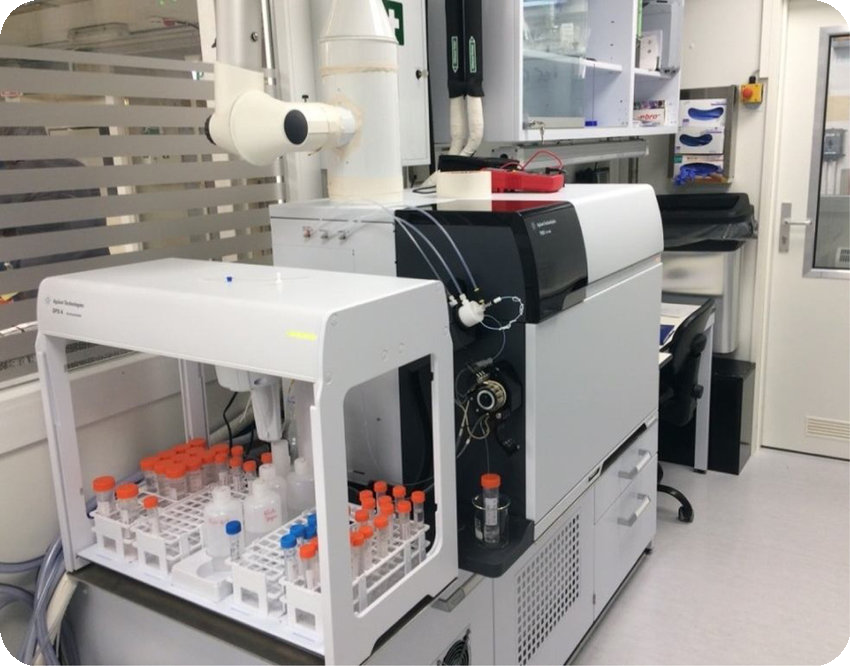
- Implemented the full GMP equipment lifecycle for a new ICP-MS and closed-vessel microwave digestion platform, from URS through change control release.
- Enabled routine testing for the “big four” heavy metals (cadmium, arsenic, lead, mercury) plus antimony, which Health Canada identifies as a heavy metal of concern for cosmetics and personal care products.
- Delivered an expanded multi-element panel for both contaminant testing and elemental active ingredient assays, such as magnesium- or iron-based products.
- Developed and validated a digestion and ICP-MS method for diverse matrices, from simple lotions and APIs to challenging herbal materials.
- Established a flexible workflow supporting an abridged heavy metals run, an extended panel, or both, reducing prep time and standards usage.
Client Context
We supported the client through two connected workstreams: GMP implementation of the equipment platform, and development and validation of the analytical method.
The laboratory started from a clean slate and needed a capability that would be robust enough for routine GMP release testing, yet flexible enough to serve customers across very different sectors and product types.
The Challenge
This project combined several kinds of complexity that often collide in GMP laboratories.
A Wide Matrix Envelope
Simple matrices such as some lotions and APIs are straightforward, but botanicals and complex natural matrices can be digestion-limited and prone to interference.
Volatile and Difficult Analytes
Some elements, especially mercury, are prone to volatility or memory effects, which calls for closed-vessel digestion and deliberate controls for carryover and stability.
Multi-Sector Compliance
The method had to meet Canadian cosmetic heavy metal expectations while aligning with global pharmaceutical frameworks (ICH Q3D and compendial procedures).
What We Did
We provided end-to-end support to move the lab from a clean slate to a fully operational, validated testing suite.
1
Equipment Selection and Qualification
- Authored the User Requirement Specification (URS) and supported vendor selection on intended use, GMP fit, serviceability and long-term cost
- Coordinated installation of the ICP-MS and closed-vessel microwave digestion system
- Wrote use, maintenance and operational SOPs, plus a calibration plan for digestion sensors
- Executed qualification through change control release with URS traceability and objective evidence
2
Method Development and Optimization
- Optimized digestion programs across matrices, including siliceous herbal materials, for complete recovery of volatile elements
- Optimized ICP-MS parameters and internal standards, with additives to mitigate mercury memory effects
- Selected fit-for-purpose commercial multi-element standards
- Defined reagent and standard stability positions for routine scheduling
3
Validation and Compliance
- Built a URS traceability matrix so every requirement was tested
- Drafted and executed validation protocols aligned with USP, ICH Q3D and Ph. Eur. expectations
- Authored validation reports, the master SOP and training materials for controlled deployment
Final List of Elements
The validated method covers a broad multi-element panel:
The Approach
Our strategy focused on three core pillars.
Full Lifecycle Integration
We didn’t just install a machine; we integrated it into the client’s QMS through robust change control and traceable documentation.
Ruggedness by Design
A strong focus on digestion so even tough herbal materials were fully mineralized, the foundation of reliable ICP-MS data.
Tiered Testing Efficiency
A flexible abridged-versus-extended configuration lets the lab batch sample types together, saving standards and prep time.
Deliverables
1
GMP Qualification Package
URS, traceability matrix, change control documentation and equipment SOPs.
2
Validated Analytical Method
A robust procedure covering the full element panel across matrices.
3
Validation Documentation
Harmonized USP/ICH/Ph. Eur. protocols and execution reports.
4
Training Package
Content to align analysts on new ICP-MS workflows and sample prep.
Lessons Learned
Elements have their own personalities. Lead appears if glassware is used in sample prep, mercury sticks to plastic, and many elements change ionization behaviour with matrix components.
An autosampler enclosure is a good investment. Even in a clean facility, dust carries calcium, magnesium, sodium and more into open sample and calibration tubes.
Closed-vessel digestion is mandatory. For diverse product lines, it is the only way to reliably recover volatile elements like mercury and selenium.
Matrix matters. One-size-fits-all digestion often fails on siliceous or high-fat samples; a worst-case protocol builds ruggedness for future sample types.
Flexibility drives ROI. Batching abridged and extended runs together cuts the cost of multi-element standards and cleaning cycles.
Planning a New Method or Instrument?
If you need a GMP qualification and validation package that will stand up to audits, we can help you define “good,” execute efficiently and embed the program into your QMS. Book a free consultation.